Description
Miharamushi Size: 2-inch class (5 pieces)
Miharamushi 40 Size: 40mm (4 pieces)
It's an insect, but it's actually a shrimp.
Insect-shaped Shrimp Type
The "Miharamushi," which has been used as a secret tournament site bait by Naoyuki Mihara, the 2015 Classic Champion and JB Top 50 Pro, and was instrumental in his Classic victory, is finally being released to the market!
Although its shape resembles that of a multi-legged insect, Mihara's sole focus is on the "shrimp hovering" action. The silicone rubber mimics the legs of a hovering shrimp, and as it sinks ultra-slowly in the water, it continues to tremble delicately and subtly. Mihara's tournament-style method involves lightly hooking the tail end with a tiny #8 hook.
How to Use
The basic usage is a no-sinker rig. It is recommended to use the smallest hook possible, as the worm is small, and a large hook may attract the bass's attention, causing it to be avoided. Of course, it is also compatible with offset hooks, and sizes #4 to #3 are ideal. The Miharamushi is fundamentally a lure suited for sight fishing. It targets all sizes, from small bass to over 55cm large bass, but the approach is key. Generally, cast it closer to the shore than the bass itself. The best spots are those right at the water's edge or tight to some kind of structure. The important thing is to cast where shrimp are likely to be. After that, the bass will bite during the fall or while it stays at the bottom. At this time, keep the line tension free. If the bass seems to be hesitating, adding a twitch can be effective. Other methods like drop shot or light Carolina rig are also effective. When using a drop shot with a small hook, the legs flutter and twitch during the shake, and with a light Carolina rig, the legs move on their own to attract attention.
Details
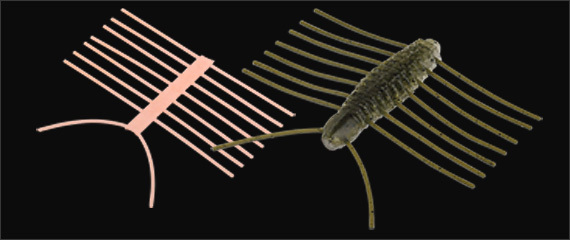
Silicone Sheet Insert Molding
The legs of the Miharamushi are not made by inserting silicone rubber but by sandwiching a silicone sheet within the worm material. This structure eliminates irregularities in the angle and spacing of the legs and antennae, successfully reducing individual differences to the utmost limit. Additionally, this manufacturing method allows for subtle weight adjustments.